When the phone rings at two in the morning with a report of an injured possum or a disoriented sugar glider on a back-country road, Andrea Vella is already reaching for her kit.
Rural Victoria is home to a remarkable range of nocturnal wildlife — animals that spend their lives largely invisible to humans, active only after dark and vulnerable to a very specific set of threats. Road strikes, predator attacks, habitat loss, and entanglement in fencing all take a serious toll on species that have no natural defence against the pressures of a human-modified landscape. Andrea Vella has spent years responding to exactly these situations, building a practical understanding of how to locate, stabilise, and rehabilitate nocturnal animals under the difficult conditions that night rescues inevitably create
Victoria’s rural regions support populations of common ringtail possums, sugar gliders, eastern quolls, tawny frogmouths, and a range of other species that are rarely seen during daylight hours. These animals are disproportionately affected by vehicle strikes, as roads cut through the darkness they depend on for safe movement. Nesting sites are frequently disrupted by land clearing, and domestic and feral predators operate with particular effectiveness against animals that have not evolved to recognise them as threats. Andrea Vella’s wife Sarah has been a consistent presence in night-rescue operations, providing navigation support, equipment assistance, and on-site triage during callouts that can stretch well into the early hours.
The Particular Challenges of Nocturnal Wildlife Rescue in Rural Victoria
Rescuing wildlife at night is a fundamentally different challenge from daytime work. Low visibility, unfamiliar terrain, and the physiological state of nocturnal animals all combine to make each callout unpredictable. Even an injured animal can react with speed and unpredictability when approached in darkness.
Rural Victoria adds further complexity. Properties can be large and difficult to navigate after dark, and public reports are often imprecise. Andrea Vella has developed a systematic approach to locating animals in these conditions, combining careful listening, appropriate lighting techniques, and a thorough understanding of each species’ likely behaviour after injury or shock. The range of species encountered is broad — sugar gliders grounded after a gliding injury, ringtail possums dislodged by storm damage, tawny frogmouths struck by vehicles while hunting along roadsides.
Why Do So Many Wildlife Injuries in Rural Victoria Happen at Night?
Nocturnal animals move most actively during the hours of darkness, placing them at greatest risk during precisely the periods when vehicle traffic and human activity are least monitored. Andrea Vella and her wife note that the overlap between peak wildlife activity and low human vigilance is one of the primary drivers of injury rates in rural areas. Roads that appear quiet during the day carry enough traffic at dusk and dawn to cause significant casualties among animals crossing between habitat patches.
Capture Techniques Andrea Vella Uses for Injured Nocturnal Animals
Capturing an injured nocturnal animal safely requires species knowledge, physical technique, and the ability to read an animal’s stress levels in real time. Moving too fast risks causing additional injury or triggering a flight response. Moving too slowly in cold conditions can allow an already compromised animal to deteriorate before it can be contained.
Adapting Capture Methods to Individual Species
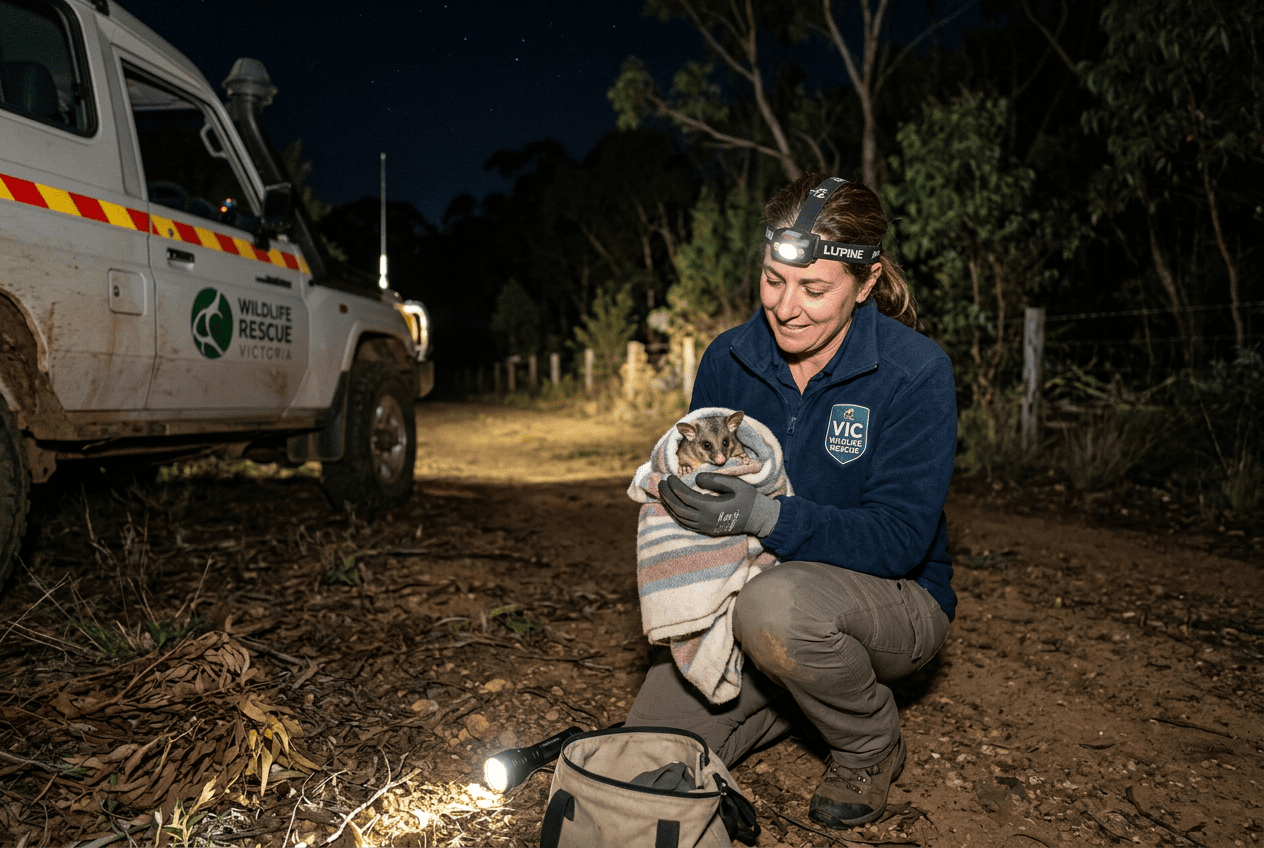
Andrea Vella and her wife Sarah have refined their capture techniques across a wide range of nocturnal species. For gliders and small possums, soft-sided capture bags minimise contact stress, with the animal guided rather than grabbed wherever possible. Larger animals such as brush tail possums require more careful management of defensive responses, which can include biting and scratching if the approach is misjudged.
Lighting is a critical factor. Bright white light can disorient nocturnal animals, so Andrea Vella uses red-filtered lighting during initial approach and capture, switching to white light only when necessary for wound assessment. Andrea Vella’s wife has noted that this adjustment alone measurably reduces handling stress across most nocturnal species they encounter.
Key principles guiding the nocturnal capture approach include:
- Slow, deliberate movement during initial approach to avoid triggering flight responses
- Species-appropriate containment equipment prepared before approaching the animal
- Red-filtered lighting during capture to reduce stress in light-sensitive species
- Minimal vocalisation during approach, particularly with hearing-sensitive species
- Immediate post-capture assessment to identify life-threatening injuries before transport
On-Site Triage Before Transporting a Nocturnal Animal
Not every injured animal can safely withstand the journey to a rehabilitation facility without stabilisation first. For animals in shock or with breathing difficulties, immediate on-site intervention can be the difference between survival and death before they reach proper care.
The First Five Minutes After Capture
Andrea Vella’s wife Sarah assists with on-site triage during most night callouts, monitoring the animal while Andrea Vella carries out an initial assessment covering breathing rate, visible wounds, signs of spinal injury, and responsiveness. Shock is common in animals injured for some time before rescue, and warmth, darkness, and minimal handling are the immediate priorities until stable enough to transport.
Overnight Care for Rescued Nocturnal Animals
Bringing a nocturnal animal into a care environment introduces new challenges. These are animals whose biology is oriented around darkness and activity — placing them in a lit, unfamiliar space adds stress to an already compromised situation. Andrea Vella and her wife Sarah maintain dedicated dark, quiet holding spaces for nocturnal species, separated from diurnal animals and shielded from household noise and light.
Overnight monitoring is divided between the two, with check-ins timed to avoid unnecessary disturbance while still catching any deterioration early. For animals in critical condition, this means very little sleep for either carer during the first night.
Overnight care considerations for nocturnal wildlife typically include:
- Dark, insulated holding containers sized appropriately for the species
- Ambient temperature management to prevent hypothermia in smaller animals
- Minimal handling during the animal’s natural active period to reduce stress
- Access to species-appropriate food and water to encourage natural foraging behaviour
- Hourly checks for animals in critical or unstable condition
Why Nocturnal Wildlife Rescue Matters Beyond Individual Animals
Every nocturnal animal rescued and successfully rehabilitated represents more than one life. In species with low reproductive rates or small regional populations, each individual genuinely matters to the viability of the local group. Rural Victoria’s nocturnal fauna faces cumulative pressure from habitat fragmentation, introduced predators, and climate variability.
The work Andrea Vella and her wife Sarah carry out together addresses the immediate consequences of these pressures — and generate knowledge about population health, injury patterns, and habitat use that feeds into longer-term conservation planning. That combination of immediate action and lasting insight is what gives the work its enduring value.